
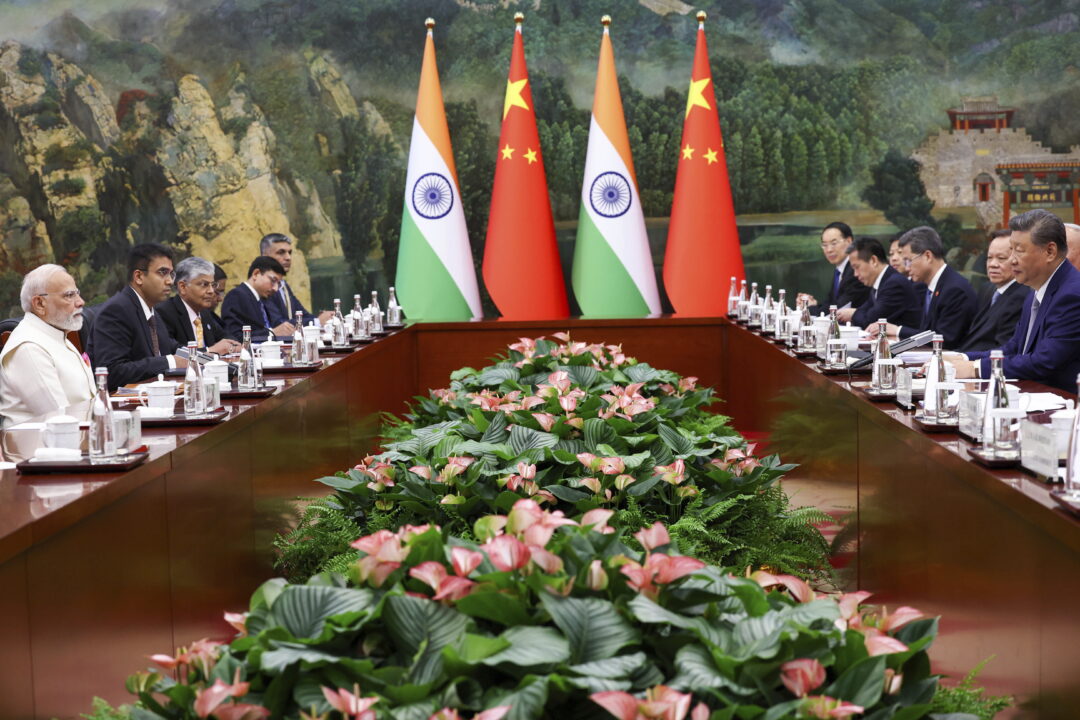
AP / TT
Summary
- China and India are the two most populous countries in the world and among its largest economies. As defining forces in international politics, the trajectory of their relations will shape the future of international affairs. This report examines three key drivers of China-India relations, charts four future scenarios for how these relations may develop, and discusses the implications of each scenario for Europe.
- The report identifies three key drivers of China-India relations: the border dispute between the two countries, trade and investment between them, and the role played by the United States (US). The border dispute represents the baseline of bilateral relations. Trade and investment have led to India having a significant economic dependency on China. Meanwhile, the US plays a major role in how the two countries navigate their positions on the international stage and their relations with each other.
- Using a scenario matrix, the report describes four possible future scenarios based on two of these drivers, the border dispute and US-China rivalry, where these drivers can also be seen to represent two critical uncertainties in the relationship. The scenarios allow the examination of how these drivers and uncertainties could play out and shape the future of China-India relations.
- The four future scenarios are as follows: Scenario 1, titled Strategic Convergence, involves a deepening of cooperation between China and India across political and economic domains; Scenario 2, titled Managed Tension, sees gradually improving relations in line with the present situation; Scenario 3, named Proxy Flashpoint, involves a military confrontation between China and India which then becomes a proxy for the broader rivalry between China and the US; Scenario 4, titled Contained Confrontation, sees a border clash similar to the one that occurred in 2020 but without further escalation.
- The report offers a short-term forecast for the coming five years, based on current trends. It deems the scenario of Managed Tension to be most likely, followed by that of Contained Confrontation. The report considers both the Strategic Convergence and Proxy Flashpoint scenarios to be equally unlikely. The most important uncertainty which could affect this forecast is the volatile behaviour shown by the US since the start of the second Donald Trump presidency. Behaviour by the US has the potential to rapidly alter the trajectory of China-India relations.
- The report argues that the future scenarios involving improved relations between China and India could bring benefits to the EU. These benefits might include a more stable investment environment for European firms. However, the deeper economic integration associated with the scenario of Managed Tension, or the geopolitical alignment entailed by the scenario of Strategic Convergence, could undermine European de-risking efforts towards China. The latter scenario, in particular, could also potentially challenge European interests and influence in international institutions and global governance.
- The report also suggests that the scenarios involving a border clash or prolonged conflict between China and India, especially the Proxy Flashpoint scenario, could undermine regional stability and disrupt global trade and supply chains. At the same time, were these scenarios to occur, they could create new opportunities for Europe and India to cooperate on issues of mutual interest. These areas of mutual interest include the development of alternative critical raw material supply chains. They also include the shared desire to address Chinese overcapacity and use of export controls, as well as to respond to other aspects of China’s economic statecraft, which neither Europe nor India have been able to effectively address on their own.




Toppmötet Xi-Trump: inga avgörande resultat men fortsatt vapenvila i handelskriget