
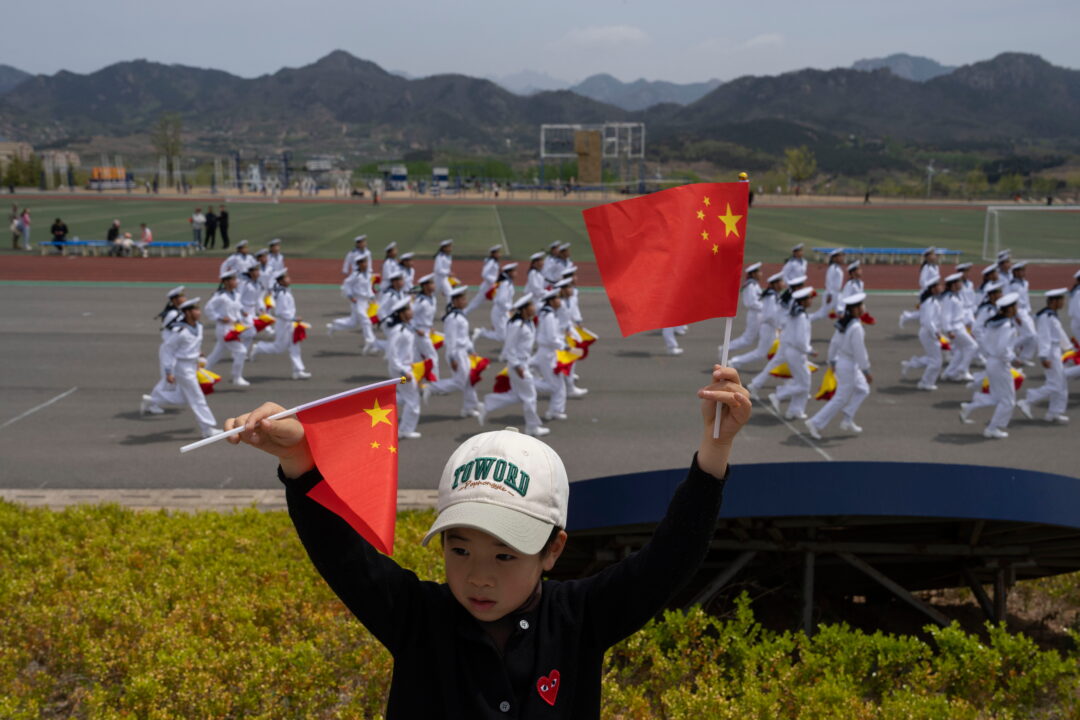
Ng Han Guan / AP / TT
Summary
- The revival of Marxism-Leninism in Chinese politics has reinvigorated the militarist traditions of China’s past, as illustrated by the resurgence of National Defence Education (NDE) since 2018.
- The overall purpose of NDE is to enhance patriotism and defence-related skills. Under Chinese leader Xi Jinping, NDE has been streamlined and there is a greater focus on combat skills, as well as on educating teenagers and younger children.
- These developments boost the presence of the military in society, blur the boundaries between civil and military, and provide a mechanism for domestic political control.
On 19 September 2026 military-related activities were organised across China. These included robotic martial arts performances, military exhibitions, hands-on demonstrations of civil air defence, schoolchildren enacting the Long March and educational sessions on how to distinguish different civil defence sirens. Under the banner “Upholding the spirit of the War of Resistance and building a great wall of national defence together” (弘扬抗战精神 共筑国防长城), the 26th National Defence Education Day was successfully completed.
The third Saturday of September was legally designated National Defence Education Day (全民国防教育日) by the 2001 Law of National Defence Education. Since then, the day has been observed annually across China, and the Chinese Communist Party (CCP) and the People’s Liberation Army (PLA) generally come together to offer citizens a variety of activities. While such undertakings may be the most visible efforts to raise public awareness and knowledge of military matters, they are far from the only ones. Attempts to mobilise Chinese society and increase the public’s role in national defence have grown significantly since Xi Jinping (习近平) assumed power in 2012.
The authoritarian and ideological turn in Chinese national politics under Xi has been thoroughly documented, but less attention has been devoted to its societal consequences. National defence education (NDE) illustrates well ongoing attempts to remove civil-military boundaries, evoke the citizen-soldier ideal and emphasise the role and status of the military in society. It also highlights general political and societal developments with far-reaching consequences. First, this overall militarisation trend does not only affect organisations and actors in China, which are required to adapt their work and priorities to national and military security needs. Second, the mobilisation efforts directed at the public, where NDE is just one of many undertakings, can also be seen as an indication of the sense of urgency felt by Chinese politicians vis-à-vis their national and international security situation.
International agencies and partners that wish to cooperate with Chinese counterparts will be required to respond and adapt to these changing perceptions of security and the militarised responses to them. The blurring of civil and military is not only a development within the Chinese education system, which is extensively used to prepare the population for a potential future conflict, but a “whole of society” approach to mobilisation as seen, for example, in the setting up of corporate militias in both state-owned and private Chinese companies.
China’s long tradition of national defence education
Like other Marxist-Leninist armies, the Chinese military has a long tradition of participating in civilian activities such as political and military education. The aim, scope and focus of the military’s education of the masses have shifted over the years. Somewhat simplified, the emphasis placed on defence education tends to co-vary with the level of politicisation of society and the perceived level of domestic threat and instability. During the radical years of the 1960s, the Chinese military was portrayed as a role model for ideological and political work and the rest of society was instructed to “Learn from the PLA”. As the Cultural Revolution disrupted the education system, the army was called on to “carry out military training of university, middle school, and older primary school students”.
In the 1980s, at the outset of the reform era, the political leadership found itself challenged by a youth uninterested in both national defence and party ideology, and national defence education was identified as a tool for strengthening the party-state and reinforcing the CCP’s mandate. As the modernisation of society gradually undermined the idea of farmers and factory workers as the political vanguard, the soldier remained the only symbol of strength, discipline and “human quality“ (素质). National defence education was introduced in universities in 1985, and its scope was temporarily expanded as a form of crisis management following the brutal suppression of student demonstrations in 1989.
The system of defence education in civilian schools developed over time. In 1994, a new set of rules made it compulsory to combine theoretical elements with practical military work. This requirement was enforced in 2001 by the National Defence Education Law, according to which defence education must be provided to all citizens through the educational system, from primary schools to universities. It also stipulates that special training should be organised for state and party leaders at all bureaucratic levels, in enterprises, social and rural organisations, and the media.
The boosting of National Defence Education under Xi Jinping
Since Xi Jinping became General Secretary of the CCP, the party has worked systematically to reinforce its grip over both state and society. These ambitions intensified following the 19th National Congress of the CCP in 2017, when Xi declared that “Party, government, military, society and education, east, west, south, north, middle, the Party leads everything”. This reinforced the Leninist party-state and the logic of Marxism-Leninism, “a combative political philosophy” that militarises political culture. It is therefore not surprising that the military, and militarised means and methods, are being reinforced in China today.
National defence education illustrates this trend. The law on national defence has been amended twice since Xi Jinping came to power, in 2018 and in 2024. Responsibility for NDE has been transferred from the State Council to CCP organs, which underlines that it is now the Party rather than the state that is in charge of NDE. The growing emphasis on NDE can be seen in the decision taken in 2023 to make the whole of September the Month of National Defence Education (全民国防教育月).
Updating the aim and content of National defence education
The amendments to the legal framework illustrate several noteworthy developments. According to the most recent revision, the aims of NDE are not only to increase defence awareness, skills and national cohesion, but also to strengthen people’s awareness of potential dangers and increase their preparedness. To achieve this, the amended law now specifies that NDE must be guided by Marxism-Leninism, Mao Zedong Thought, Deng Xiaoping Theory, the theory of “Three Represents”, the Scientific Outlook on Development and Xi Jinping Thought on Socialism with Chinese Characteristics for a New Era. It further stipulates that content should include not only national defence theories and armed forces construction, but also “science and technology, law, and psychology” (article 4). Consequently, new ways to implement NDE are required and its content must be streamlined across the country.
At universities, students generally do 2–3 weeks of military training before the start of the academic year. In times of crisis, this can be extended. In recent years, the activities students undertake as part of NDE appear to have become more hands-on and militarised, with an explicit ambition to provide the skills required in times of war or crisis. Whereas previously the mandatory training for university students primarily involved theoretical study of national defence, physical exercise and military drills, reports suggest that it now comprises combat practice to a greater extent, for example making use of guns, drones and rocket launchers.
Updating the target groups for National defence education
Under Xi, there is also greater focus on the military training of children. The aims and ambition of the CCP differ according to the age group, which naturally affects possible activities and the sought-for outcomes. For children in primary school, the aim of NDE is to bring about a sense of military awareness. This might be achieved, for example, through school visits to military sights, military song contests and physical exercise under the leadership of local military officials. For children in junior high school (12–15 years of age), the content is more clearly militarised and a tangible output is expected in terms of both basic national defence knowledge and military skills. Since 2024, military training, including combat skills, has been organised for junior high school students in a similar fashion to the programmes that were previously only a requirement in institutes of higher education and universities.
The targeting of younger children is also noticeable in the creation of model schools for national defence education. A first batch of 2,687 model schools was officially selected in 2023 after a thorough evaluation process, and an additional 2,431 schools were added in 2024. These model schools include both private and public institutions and are found at all levels from primary to senior high. Their purpose is to institutionalise civil-military exchange and build local civil-military ties between schools and military garrisons in the same region. The schools often have exhibition halls that celebrate military deeds or martyrs, sites for informing about the achievements of the CCP, as well as military training facilities. The targeting of younger children is no coincidence given the overarching aim “to cultivate a new generation that can carry forward responsibility for national rejuvenation”.
National defence education is a concern for the whole nation
Although the education system provides an effective vehicle for systematically implementing NDE, transmission takes place through several channels in order to reach the entire population. Consequently, military educational activities take place in local government, business, public institutions, and social and rural organisations throughout the year. Together, these undertakings provide the CCP, at all administrative levels throughout the country, with opportunities to enforce the significance of national defence and security, while also making clear that this responsibility rests with each and every citizen.
In addition to its focus on the practical skills needed to handle external threats, there is arguably also an internal security dimension to NDE. The promotion of patriotism from an early age can be understood as a means of political propaganda and social control. Thus, NDE is one example of the CCP using its armed branch to penetrate society and increase control. Other examples include the establishment of People’s Armed Forces Departments in private and state-owned enterprises, and the setting up of better educated militias in universities and other locations.



The limits of techno-optimism: AI, employment, and social progress in China