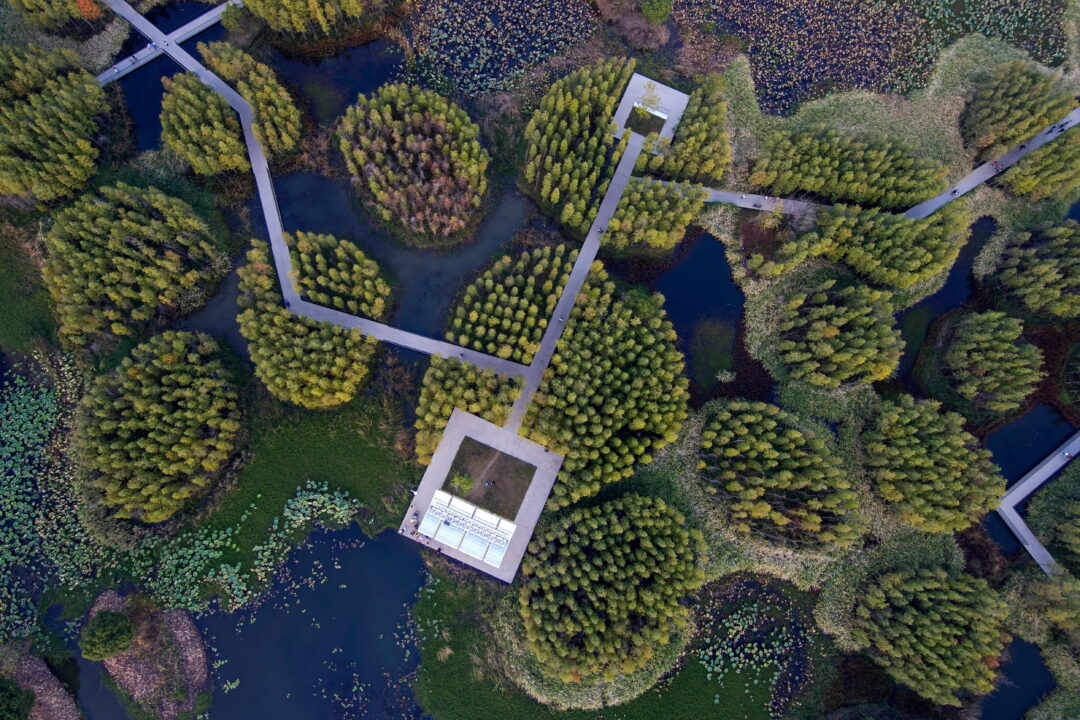
Ng Han Guan / AP / TT
Summary
- Ecological Civilization (EC) is the Chinese Communist Party’s (CCP) vision and ideological framework for its environmental work. It is a core element of Xi Jinping Thought, which, in turn, serves as the ideological roadmap for the CCP to make China into a “great modern socialist country” by 2050. In 2018, EC was incorporated into China's constitution.
- Because EC represents a fundamental part of Xi Thought, understanding it is essential for grasping the CCP's approach to environmental policy. The ambitious vision of EC positions China as the vanguard of humanity's historical development: a global transition towards the next stage of civilization.
- Purporting to on the traditions of Marxism and classical Chinese philosophy, EC advocates the so-called Two-Mountain Theory, which holds that economic development must not come at the expense of the environment. EC largely represents a continuation of China’s prevailing developmental model while placing greater emphasis on environmental sustainability.
- EC is integral to the CCP's overarching development strategies. The long-term objective of these strategies is not only to transform China into a “great modern socialist country,” but also to make it “beautiful.” Making China “beautiful” entails both general goals, such as environmental legislation, and concrete targets, such as electric vehicle sales.
- Chinese foreign policy pairs EC with the concept of a Community with a Shared Future for Mankind. EC is used as a rationale for investments in green infrastructure projects under the Belt and Road Initiative, China’s flagship global infrastructure programme. Despite China’s large-scale investments in green infrastructure, EC’s impact as green soft power remains limited.
Ecological Civilization (EC) (生态文明) encompasses the vision and the ideological framework of the Chinese Communist Party’s (CCP) environmental agenda. As both a vision and a framework, it paints a vivid picture of China’s green future while outlining a path to reach it. EC is a constitutive part of the broader ideological architecture of Xi Jinping Thought on Socialism with Chinese Characteristics for a New Era (hereafter Xi Thought) (习近平新时代中国特色社会主义思想). As such, it serves as the essential roadmap endorsed by the CCP that will “guide China’s ship of state to its destiny.”[i] Since EC is integral to Xi Thought, it is copiously invoked in Chinese political discourse, used interchangeably as a slogan, policy orientation, historical trajectory, and worldview. This brief provides an overview of EC’s core tenets and its use as a political strategy.
To contextualise the emergence of EC in China, this brief will chart its ascent in the Chinese intellectual landscape. Thereafter, I analyse EC’s conceptual make-up of Marxism and classical Chinese philosophy, arguing that its ideological thrust is to be found in a nationalist developmentalism. By situating EC within the CCP’s overarching developmental strategies, I further show its differing marketing domestically and abroad, highlighting how the CCP attempts to use it as green soft power internationally. Finally, the brief offers a reflection on EC's future prospects.
The Chinese literature on Xi Jinping Thought on Ecological Civilization
While there is a large body of research on EC in general, less attention has been paid to how the concept works as a building block within Xi Thought's overall architecture. Under Xi’s rule, the CCP has adopted an increasingly centralised political system, abolished presidential term limits, and shifted towards a more personalised style of leadership. Combined with Xi’s ambition to change the CCP, the country, and the people, this makes reading Xi Thought essential to understanding the CCP’s overall plans, strategies, and vision for the future.[ii] Because EC represents a fundamental part of Xi Thought, understanding EC is essential for grasping the CCP’s approach towards environmental policy.[iii]
EC has been extensively covered and analysed in the Chinese media. Already in 2017, it was estimated that there were more than 4,000 published books and articles on the topic, as well as over 170,000 articles in the Chinese mainstream media.[iv] Two books on Xi Thought on EC serve as the main primary sources for this brief: Study Outline for Xi Jinping’s Ecological Civilization Thought (hereafter Study Outline) (习近平生态文明思想学习纲要) and Theoretical Construction and Practical Research on Building Ecological Civilization: Learning Xi Jinping Thought on Socialism with Chinese Characteristics for a New Era (hereafter Theoretical Construction).[v] These books represent material that facilitates “thought reform” (思想改造), a crucial endeavour in the CCP’s efforts to propagate its ideology and educate the people.[vi] Study Outline is an official propaganda publication written to guide party committees and leading party members' groups in their educational efforts, helping them implement Xi Thought on EC in society. Whereas propaganda in English often has negative connotations, it is regarded positively in CCP language as a pedagogical tool for thought reform.[vii] Theoretical Construction is an academic publication with an express ambition to produce new theory. The book is attributed to the prominent researcher Pan Jiahua (潘家华) and his team at the Chinese Academy of Social Sciences.
A short history of Ecological Civilization
The Chinese trajectory of EC began in the mid-1980s, when it was used sporadically by scholars as a translation of a Russian term. Although the concept circulated in the academic sphere for the next two decades, it was never popularised in public discourse. EC first appeared in a central policy document in 2007; however, it was only when former General Secretary Hu Jintao (胡锦涛) mentioned it in his work report to the 17th National Party Congress that it gained traction as part of CCP terminology. The adoption of EC was not driven by any inherent theoretical persuasiveness but emerged from the CCP’s failure to protect the environment despite the promises of its then-rhetoric of “sustainable development” (可持续发展).[viii] In the 2000s, China was beset by ecological degradation and, in 2007, several widely covered environmental conflicts sparked an intense national debate about environmental pollution.[ix] In the face of its environmental shortcomings, the CCP needed a new concept to legitimise its future environmental work, and the choice fell on EC.[x]
Following Hu’s work report, he devoted an entire section to EC in his subsequent report to the 18th Party Congress in 2012. This catapulted the concept to prominence in CCP discourse. Hu’s successor, Xi Jinping, has since made EC into the guiding star of the Chinese government's environmental work. During the 19th National Congress in 2017, EC was revealed as one of the cornerstones of Xi Thought. In 2018, EC was incorporated into China's constitution. These changes prompted a major re-organisation of different government departments working on the environment and climate, which were merged into the giant Ministry of Ecology and Environment.[xi]
The make-up of Ecological Civilization
EC in Xi Thought purports to draw on two traditions: Marxism and classical Chinese philosophy. Study Outline and Theoretical Construction are interspersed with quotations from both. These invocations seldom enlighten the reader about the conceptual meaning of EC. Instead, they appear mainly as rhetorical flourishes: to furnish an impression rather than to deliver analysis, especially so in the latter case. Previous research has argued that the potential appeal of EC lies not in theory, but in its socio-technological imagery, in which a collective can realise a desirable vision through and with the support of scientific and technological progress.[xii]
Ecological Civilization and Marxism
EC’s projection of the future is prophetic, anticipating the arrival of a new epoch: Ecological Civilization. This projection stems from the CCP’s linear view of history, by which society advances through progressive stages towards a goal.[xiii] Time is divided linearly into distinct historical stages, each associated with a specific mode of production: Primitive Civilization, Agricultural Civilization, the current Industrial Civilization, with the next stage being Ecological Civilization.[xiv] The foundation of this new mode of production in EC is the Two-Mountain Theory (两山理论), encapsulated in the slogan “lucid waters and lush mountains are invaluable assets” (绿水青山就是金山银山).[xv] While Theoretical Construction elaborates on the Two-Mountain Theory at length, the gist is that economic development should not be achieved at the expense of the environment, that the environment should take precedence if there is a conflict between the two, and that green development can benefit general economic development.[xvi]
The “newness” of the new mode of production is that ecological considerations should permeate and be prioritised systemically across all systems, an approach labelled as “system theory”.[xvii] Such systems thinking has a long history in China and became fundamental to Maoist political philosophy.[xviii] Theoretical Construction argues that this new mode of production is a reinterpretation of productivity, in which the integration of how to “know, transform, use and protect nature ... constitutes productivity, which achieves harmony between man and nature.”[xix] In this mode of production, “development can be accelerated and the ecology can be protected at the same time ... the key lies in the choice of developmental model and developmental path.” The message is therefore that economic development can continue as usual, and even be sped up, as long as environmental “red lines” are not crossed, defined as “bottom line and lifelines of national ecological security.”[xx] Despite such claims, EC arguably does not represent a new mode of production; rather, as scholars Mette Halskov Hansen, Hongtao Li, and Rune Svarverud have remarked, it is “well adapted to the capitalist order.” In other words, it advocates continued, even accelerated economic growth, without any redistributive measures.[xxi]
Ecological Civilization and Classical Chinese Philosophy
In its Marxist language, EC asserts universality by charting out a history for all of humankind. However, like “socialism with Chinese characteristics,” there is an intrinsic tension in this supposed universality and its particularity as something “Chinese.” EC’s Chinese-ness is predominantly bolstered by assertions that it builds on classical Chinese philosophy. Theoretical Construction and Study Outline are both sprinkled with quotes from classical Chinese thinkers, but these quotes inform the reader only insofar as China’s distant past included philosophers who reflected on nature, though even this can be misleading. A salient example is the use of one of the most famous lines from the Daodejing, “dao fa ziran” (道法自然), which appears in both Study Outline and Theoretical Construction; in the latter it is rendered in English as “Dao operates naturally.”[xxii] Although ziran is sometimes translated as “natural” or “naturally,” in this passage, it refers to naturally as in “spontaneously so” or “itself.”[xxiii] Ziran here is a cosmological idea, differing markedly from its modern Chinese meaning and CCP usage, in which it refers to “nature” as something separate from and potentially engineered by society.
Another example of the selective use of Chinese classical philosophy is the absence of the concept of wuwei (無爲), often translated as nonaction or effortless action.[xxiv] In Daoist philosophy, wuwei and ziran cannot be cleanly separated and are conjoined as spontaneity that has come about effortlessly.[xxv] Wuwei refers to a state of mind in which actions are “characterized by a feeling of spontaneous ease and graceful effortlessness.”[xxvi] Such a state of mind would have been antithetical to the CCP’s system thinking with regards to developing nature. While ziran means nature in modern Chinese, making it easier to superimpose an anachronistic interpretation, wuwei remains a philosophical concept associated with Daoism and effortless/nonaction. This is likely why wuwei has been entirely excluded from official EC discourse.
These instances in which EC invokes Chinese philosophy illustrate that such references are not intended for rigorous engagement; rather, I argue, they function as a deliberate “invention of a tradition” to “socially engineer” a nationalism in pursuit of development.[xxvii]
Ecological Civilization and developmentalism in the name of the nation
EC embodies what has been described as “the techno-optimistic mentality that humans can solve the twin crises of poverty and ecological destruction through better engineering.”[xxviii] This is a comforting and placatory vision: it demands absolute trust in the CCP’s ability to fix the environment while discouraging criticism towards its policies. Ideologically, EC needs to flash its Marxist and Chinese philosophy credentials to legitimise the CCP, while also delivering reassurance that environmental problems can be fixed without surrendering economic development. These concerns are all addressed in the name of the nation: China, under the CCP's governance, will emerge green and triumphant if it continues to develop along its current trajectory.
Nationalism is crucial to this project because it galvanises the people to support the CCP through chauvinism, while deflecting blame from the party. This nationalism becomes conspicuous in EC’s identification of the environmental culprit: the “West.” Theoretical Construction declares that “contemporary ecological problems are [because] Westerners always believe that everything has its vanquisher.” Interestingly, the “vanquisher” approach is described as Westerners’ belief that all problems can be solved by technology alone, which has exacerbated ecological destruction. The solution lies in recognising that nature has its own value by drawing on “Oriental wisdom” and the Chinese people’s “spiritual home.”[xxix] While this rhetoric ostensibly undermines developmentalism embodied in the “vanquisher approach,” the underlying message of EC is essentially the same as what the authors criticise: high-velocity capitalist production. The distinction, as I have shown, lies only in EC's insistence that developmentalism should not cross certain red lines.
The authors plot this divide between the West and China onto the “stagist” model of history, writing that the current stage of Industrial Civilization, which originated in the West and represents the “vanquisher” approach, has produced great material wealth, but at a terrible environmental cost. China must avoid following the “old path” of Western Industrial Civilization and push forward on a new one to reach the stage of Ecological Civilization.[xxx] As a result, both China and the West function as geographies of time: the West represents the present historical moment, whereas a developed Chinese nation as an Ecological Civilization is cast as the future. In this way, the development of the Chinese nation becomes the engine of history.
Ecological Civilization in the CCP’s developmental strategy
Within the ideological architecture of Xi Thought, EC serves as a node to legitimise the CCP and its developmentalist environmental politics. Strategy-wise, as a plan of action that includes the means to reach a goal,[xxxi] EC is one guidepost in Xi Thought's roadmap, with the final objective of realising the “China Dream of national rejuvenation.”[xxxii] Xi first began promoting the idea of the China Dream in 2012, and over time, it became his “ultimate vision” to build China into a “great modern socialist country that is prosperous, strong, democratic, culturally advanced, harmonious, and beautiful” by 2050.[xxxiii] EC has a necessary role in such a new China, because the “beautiful” in this future refers to having reached the stage of Ecological Civilization.
There are two overarching developmental strategies to be followed in order for China to become a “great modern socialist country”: the Five-Sphere Integrated Plan (五位一体总体布局) and the Four-Pronged Comprehensive Strategy (四个全面战略布局).[xxxiv] The Five-Sphere Integrated Plan dates back to 1986, when the CCP proposed an overall plan for China's development with the economy at its core, and in 2012, EC was integrated into the plan.[xxxv] The Four-Pronged Comprehensive Strategy is of more recent provenance, first proposed by Xi in 2014 .[xxxvi] Compared with the five spheres, in which EC represents one sphere, EC is supposed to be comprehensively implemented across all four prongs.[xxxvii] That EC is an integral part of both strategies underscores that China's greening is not only part and parcel of the CCP’s lofty ideal for the future, but also a tangible goal to be achieved.
Domestically, EC is projected together with the imagery of a Beautiful China (美丽中国) (hence the “beautiful” in the great modern socialist country formulation outlined above).[xxxviii] The idea of Beautiful China first appeared in Hu Jintao’s report to the 18th National Congress, in which he called for the building of a “beautiful homeland with green fields, clean water, and blue skies.”[xxxix] It was further developed in Xi’s report to the 19th National Congress, which devoted a section to “speeding up reform of the system for developing an Ecological Civilization, and building a Beautiful China,” advocating for “promoting green development,” “solving prominent environmental problems,” “intensifying the protection of ecosystems,” and “reforming the environmental regulations system.”[xl]
Study Outline, an explicit propaganda work, instructs readers on Beautiful China. One of the activities it discusses is captured by the slogan “Beautiful China, I take action” (美丽中国,我是行动者), which is also the name of an action plan.[xli] The plan, published in early 2021, spanned 2021–2025 and aimed to “enhance public awareness of Ecological Civilization.” It outlined that 2021 would focus on the widespread dissemination of EC, followed in 2022 by a deepening of education, research, and EC volunteering initiatives. In 2023, localities were asked to foster active participation from party and government organs, enterprises and institutions, mass organisations, and social organisations in EC construction. The following year, 2024, outstanding EC models were to be selected, promoted, and best practices shared. The plan would conclude in 2025 with evaluation and commendations.[xlii] As of early 2026, no public assessment of the action plan's implementation has been released.
In January 2024, the CCP Central Committee and the State Council jointly set a series of Beautiful China targets for 2027 and 2035.[xliii] Some of the 2027 targets had already been achieved by early 2026.
- Electric vehicles: 45% of new car sales by 2027 (achieved).
- Zero Waste Cities: 60% of cities by 2027 (cities that minimise the generation of solid waste and maximise recycling and disposal), with all cities achieving this by 2035.
- Beautiful Villages: 40% of villages by 2027 (villages that are prosperous, civilised, and liveable), with a "beautiful countryside” realized by 2035.
- Air quality: Particulate matter (PM2.5) reduced to 28 µg/m³ by 2027 (achieved), and below 25 µg/m³ by 2035.
- Surface water quality: 90% of surface water of “good” quality (water suitable for human use after treatment) (achieved).
Ecological Civilization in foreign policy
Abroad, EC is paired with the concept of a Community with a Shared Future for Mankind (CSFM) (人类命运共同体). CSFM functions similarly to EC for China’s foreign policy, serving as both a global vision of a shared future and an ideological framework within Xi Thought. In this shared future, China will be “an important participant, contributor and leader in building a global Ecological Civilization.”[xliv]
Much like EC, CSFM straddles a tension between the universal and the particular. This tension finds relief in an expression of Sino-centrism with universal claims.[xlv] While CSFM may appear universal at first glance, it relies on a reinvention of the tradition of tianxia, or “all under heaven,” a concept with diverse meanings throughout China’s history, mostly representing different Chinese mappings of the world. In the same way that EC relies on selective quotations of classical Chinese philosophy, tianxia has taken on mythical proportions in Xi Thought, devoid of deeper historical meaning while signalling an arbitrary “Chinese-ness.” Its essential purpose is to promote a cloaked Chinese nationalism, or Sino-centrism, on the international stage.[xlvi] In Theoretical Construction, China’s contribution to EC in CSFM is expressed more concretely as taking a leading role and reshaping global governance, particularly by strengthening South–South cooperation.[xlvii]
While EC is prescribed through propaganda within China, the CCP cannot use the same approach abroad, and its success has been limited internationally. On the Chinese government’s English-language website is a framework entitled “Guidance on Promoting Green Belt and Road” (the Belt and Road Initiative, BRI, is China’s global infrastructure programme). The importance of EC is established in the first sentence about the Green BRI’s significance: “Promoting green Belt and Road is an internal need to share the ecological civilization philosophy and achieve sustainable development.”[xlviii] The BRI was officially launched in 2013, and the “Green BRI” was first proposed in 2017 at the inaugural BRI Forum.[xlix] As per Theoretical Construction's advice to favour South–South cooperation, such green infrastructure projects have typically involved Global South partners.[l] Chinese firms have pledged at least 227 billion USD to green manufacturing projects abroad since 2022, with more than 80 percent of new projects launched during this period.[li] By 2025, China had become the “world's renewable-energy superpower,” providing people with cheap green energy while bringing the country economic and political advantages.[lii]
Nonetheless, the reception of China’s international push for EC does not match its green manufacturing investments. According to one scholar, “China’s green soft power, while on the rise globally, remains relatively weak.”[liii] The 2022 United Nations Biodiversity Conference (COP-15), the first major UN environmental conference to be presided over by China, was illustrative of this. Under the presidency of China’s Minister of Ecology and Environment Huang Runqiu (黄润秋), COP-15 saw the brokering of a new global biodiversity framework, a “watershed moment in China’s international environmental leadership.”[liv] The chosen theme for COP-15 was “ecological civilization building,” and personages such as the director of the UN Environment World Conservation Monitoring Center spoke of the theme positively.
Yet delegates’ resonance with the concept varied, and EC’s persuasiveness remained limited in the end.[lv] One reason for this may be that EC's vision is difficult to immediately grasp, given its ambiguous conceptual makeup and underlying Sino-centrism, which complicates its international promotion. Nonetheless, the ideal of EC is arguably most convincing not at the level of rhetoric but through persuasion by showing what China can achieve domestically (and abroad): green development on a scale never seen before. After all, to quote one team of scholars: “Expanded international climate diplomacy efforts offer China a means to increase its global influence and reputational capital, though such efforts may only succeed if it can also demonstrate a successful low-carbon transition domestically.”[lvi]
Is the concept of Ecological Civilisation here to stay?
EC will most likely continue to be broadcast domestically since it is a fundamental part of building China into a “great modern socialist country” that is “beautiful” by 2050. This is especially so if the CCP manages the double feat of maintaining high economic growth while decarbonising China. However, if the party fails in this endeavour, EC’s ideological persuasiveness would erode, and the concept could suffer the same fate as “sustainable development.” However, even if this were the case, it is improbable that the CCP would abandon the concept of EC as long as Xi Jinping remains in power, given the importance assigned to EC in Xi Thought and the importance Xi places on the ideological framework that bears his name.
On the international stage, EC’s ambiguity and Sino-centrism may make it less attractive for a global audience than for a domestic one. Yet, China's growing prominence on many climate and environmental fronts, particularly given its dominance in many green technologies, may make EC an increasingly attractive model for Global South countries in their own green transitions. China has an ambition to take on a greater leadership role in global climate governance. This ambition comes amid mounting international pressure for China to do so, especially following the US withdrawal from climate agreements during Donald Trump's second presidency. In these circumstances, while EC is already deployed as a strategic narrative by China (that is, narratives whose primary purpose is “to influence the behaviour of others”),[lvii] it may increasingly also be adopted as a strategic narrative for actors seeking to engage and collaborate with China bilaterally and internationally.
[i] Steve Tsang and Olivia Cheung, The Political Thought of Xi Jinping (Oxford: Oxford University Press, 2024), 3.
[ii] Tsang and Cheung, Political Thought of Xi Jinping, 4.
[iii] Tsang and Cheung, Political Thought of Xi Jinping, 1–11.
[iv] Jean Yves Heurtebise, “Sustainability and Ecological Civilization in the Age of Anthropocene: An Epistemological Analysis of the Psychosocial and ‘Culturalist’ Interpretations of Global Environmental Risks,” Sustainability 9, no. 8 (2017): 7; Mette Halskov Hansen, Hongtao Li, and Rune Svarverud, “Ecological Civilization: Interpreting the Chinese Past, Projecting the Global Future,” Global Environmental Change 53 (2018): 195.
[v] I read the English translation of Theoretical Construction for this brief. Study Outline has not been translated. There is a notable discrepancy between the two versions of Theoretical Construction: the original Chinese edition is 294 pages, whereas the English translation is only 179 pages. Typically, an English translation of 10 Chinese pages would amount to around 15 pages in English. Furthermore, on the cover of the English edition, the title appears as China’s Global Vision for Ecological Civilisation: Theoretical Construction and Practical Research on Building Ecological Civilisation, but in the preface, it is stated as Theoretical Construction and Practical Research on Building Ecological Civilization: Learning Xi Jinping Thought on Socialism with Chinese Characteristics for a New Era. Whether this discrepancy reflects an editorial oversight or an attempt to distance the book from Xi Thought is unclear. I have chosen to cite the latter title, as it explicitly positions the work within Xi Thought literature. While the short version of the Chinese title does not include the wording of Xi Thought, the original Chinese book is nevertheless clearly a work of Xi Thought, as it was published in a series dedicated to that literature.
[vi] Timothy Cheek, “Thought Reform,” in Afterlives of Chinese Communism: Political Concepts from Mao to Xi, ed. Christian Sorace, Ivan Franceschini, and Nicholas Loubere (Canberra: ANU Press, 2019), 287.
[vii] Propaganda is defined broadly as "publicly disseminated information that serves to influence others in belief and/or action," and more specifically as xuanchuan (宣传) in the Chinese context, aimed at providing political guidance for the transformation of people into "full citizens." Jonathan Auerbach and Russ Castronovo, "Introduction: Thirteen Propositions About Propaganda," in The Oxford Handbook of Propaganda Studies, ed. Jonathan Auerbach and Russ Castronovo (Oxford: Oxford University Press, 2013), 6; Timothy Cheek, "China's Directed Public Sphere: Historical Perspectives on Mao's Propaganda State," in Redefining Propaganda in Modern China, ed. James Farley and Matthew D. Johnson (Routledge, 2021), 41.
[viii] Coraline Goron, “Ecological Civilisation and the Political Limits of a Chinese Concept of Sustainability,” China Perspectives 2018, no. 4 (2018): 41.
[ix] Yang Dongping, “Introduction,” in The China Environment Yearbook, Volume 3: Crises and Opportunities, ed. Yang Dongping (Leiden: Brill Academic Publishers, 2009), xxi–xxiii.
[x] Goron, “Ecological Civilisation and the Political Limits,” 41–42.
[xi] Goron, “Ecological Civilisation and the Political Limits,” 41.
[xii] Hansen, Li, and Svarverud, “Ecological Civilization,” 196.
[xiii] Dipesh Chakrabarty, Provincializing Europe: Postcolonial Thought and Historical Difference (Princeton, NJ: Princeton University Press, 2009), 6–11.
[xiv] Pan Jiahua, Theoretical Construction and Practical Research on Building Ecological Civilization: Learning Xi Jinping Thought on Socialism with Chinese Characteristics for a New Era, trans. Wu Dan (Singapore: Springer, 2021), 2.
[xv] A more literal translation would be "clear waters and green mountains are gold and silver mountains." Pan, Building Ecological Civilization, 25.
[xvi] Pan, Building Ecological Civilization, 25–37.
[xvii] Pan, Building Ecological Civilization, 30.
[xviii] Sigrid Schmalzer, “Prometheus and the Fishpond: A Historical Account of Agricultural Systems and Eco-Political Power in the People’s Republic of China,” Made in China Journal 7, no. 2 (July–December 2022): 127.
[xix] Pan, Building Ecological Civilization, 47.
[xx] Pan, Building Ecological Civilization, 74.
[xxi] Hansen, Li, and Svarverud, “Ecological Civilization,” 197.
[xxii] Bian Ji and Ren Min, eds., Study Outline for Xi Jinping’s Ecological Civilization Thought (习近平生态文明思想学习纲要) (Beijing: People’s Publishing House, 2022), 18; Pan, Building Ecological Civilization, 110.
[xxiii] Roger T. Ames and David L. Hall, Dao De Jing: A Philosophical Translation (New York: Ballantine Books, 2010), 115; Paul Fischer, The Annotated Laozi: A New Translation of the Daodejing (Albany: State University of New York Press, 2023), 123.
[xxiv] Goron, “Ecological Civilisation and the Political Limits,” 42.
[xxv] Edward Slingerland, Effortless Action: Wu Wei as Conceptual Metaphor and Spiritual Ideal in Early China (New York: Oxford University Press, 2007), 97.
[xxvi]Slingerland, Effortless Action, 8.
[xxvii] Eric Hobsbawm, “Introduction: Inventing Traditions,” in The Invention of Tradition, ed. Eric Hobsbawm and Terence Ranger (Cambridge: Cambridge University Press, 2000), 13.
[xxviii] Schmalzer, “Prometheus and the Fishpond,” 125.
[xxix] Pan, Building Ecological Civilization, 57.
[xxx] Pan, Building Ecological Civilization, 114.
[xxxi] David J. Hess, “Cooler Coalitions for a Warmer Planet: A Review of Political Strategies for Accelerating Energy Transitions,” Energy Research & Social Science 57 (2019): 2.
[xxxii] Tsang and Cheung, Political Thought of Xi Jinping, 32.
[xxxiii] Tsang and Cheung, Political Thought of Xi Jinping, 28.
[xxxiv] Bian and Ren, Ecological Civilization Thought, 2.
[xxxv] State Council Information Office of the People’s Republic of China, “The Five-Sphere Integrated Plan,” July 13, 2022, http://english.scio.gov.cn/m/featured/chinakeywords/2022-07/13/content_78321909.htm
[xxxvi] State Council Information Office of the People’s Republic of China, “The Four-Pronged Comprehensive Strategy,” July 13, 2022, http://english.scio.gov.cn/m/featured/chinakeywords/2022-07/13/content_78321907.htm
; David Bandurski, “Four Comprehensives,” China Media Project, August 12, 2022, https://chinamediaproject.org/the_ccp_dictionary/four-comprehensives/
[xxxvii] Pan, Building Ecological Civilization, 9–11.
[xxxviii] Pan, Building Ecological Civilization, 1; Bian and Ren, Ecological Civilization Thought, 92.
[xxxix] China.org.cn, “CPC Advocates Building ‘Beautiful’ China,” November 8, 2012, http://www.china.org.cn/china/18th_cpc_congress/2012-11/08/content_27051794.htm
[xl] Xi Jinping, “Secure a Decisive Victory in Building a Moderately Prosperous Society in All Respects and Strive for the Great Success of Socialism with Chinese Characteristics for a New Era,” China Daily, November 4, 2017, https://www.chinadaily.com.cn/china/19thcpcnationalcongress/2017-11/04/content_34115212.htm
[xli] Bian and Ren, Ecological Civilization Thought, 97.
[xlii] Ministry of Ecology and Environment of the People’s Republic of China, “‘Beautiful China, I Am an Actor’: Action Plan to Raise Citizens’ Ecological Civilization Awareness” (“美丽中国,我是行动者” 提升公民生态文明意识行动计划) (issued February 23, 2021), 6.
[xliii] Dimitri De Boer and Danting Fan, “Targets Set for ‘Beautiful China,’” China Council for International Cooperation on Environment and Development, February 2, 2024, https://cciced.eco/ecological-progress/targets-set-for-beautiful-china/
[xliv] Pan, Building Ecological Civilization, 137.
[xlv] Tsang and Cheung, Political Thought of Xi Jinping, 172–174.
[xlvi] Tsang and Cheung, Political Thought of Xi Jinping, 174–176.
[xlvii] Pan, Building Ecological Civilization, 151.
[xlviii] Ministry of Ecology and Environment of the People’s Republic of China, “Guidance on Promoting Green Belt and Road,” June 28, 2017, https://english.mee.gov.cn/Resources/Policies/policies/Frameworkp1/201706/t20170628_416864.shtml
[xlix] Geng Qingge and Kevin Lo, “China’s Green Belt and Road Initiative: Transnational Environmental Governance and Causal Pathways of Orchestration,” Environmental Politics 32, no. 7 (2023): 1163–1164.
[l] Jesse Rodenbiker, “Ecological Civilization Goes Global: China’s Green Soft Power and South–South Environmental Initiatives,” in Understanding China amid Change and Cooperation: 2022–2023 Wilson China Fellowship Report (2023), 322.
[li] Xue Xiaokang and Mathias Larsen, China’s Green Leap Outward: The Rapid Scale‑Up of Overseas Chinese Clean‑Tech Manufacturing Investments (Net Zero Industrial Policy Lab, 2025), 3–5.
[lii] “The World’s Renewable Energy Superpower,” The Economist, November 3, 2025, https://www.economist.com/special-report/2025/11/03/the-worlds-renewable-energy-superpower
[liii] Rodenbiker, “Ecological Civilization Goes Global,” 320.
[liv] Rodenbiker, “Ecological Civilization Goes Global,” 326.
[lv] Rodenbiker, “Ecological Civilization Goes Global,” 330–331, 335.
[lvi] Joanna I. Lewis, Xiaoli Zhang, and Fei Teng, “China in Twenty‑Five Years of Global Environmental Politics: The Case of Climate Diplomacy,” Global Environmental Politics 26, no. 1 (2026): 19.
[lvii] Alister Miskimmon, Ben O’Loughlin, and Laura Roselle, “Introduction,” in Strategic Narratives: Communication Power and the New World Order, ed. Alister Miskimmon, Ben O’Loughlin, and Laura Roselle (New York: Routledge, 2013), 2.