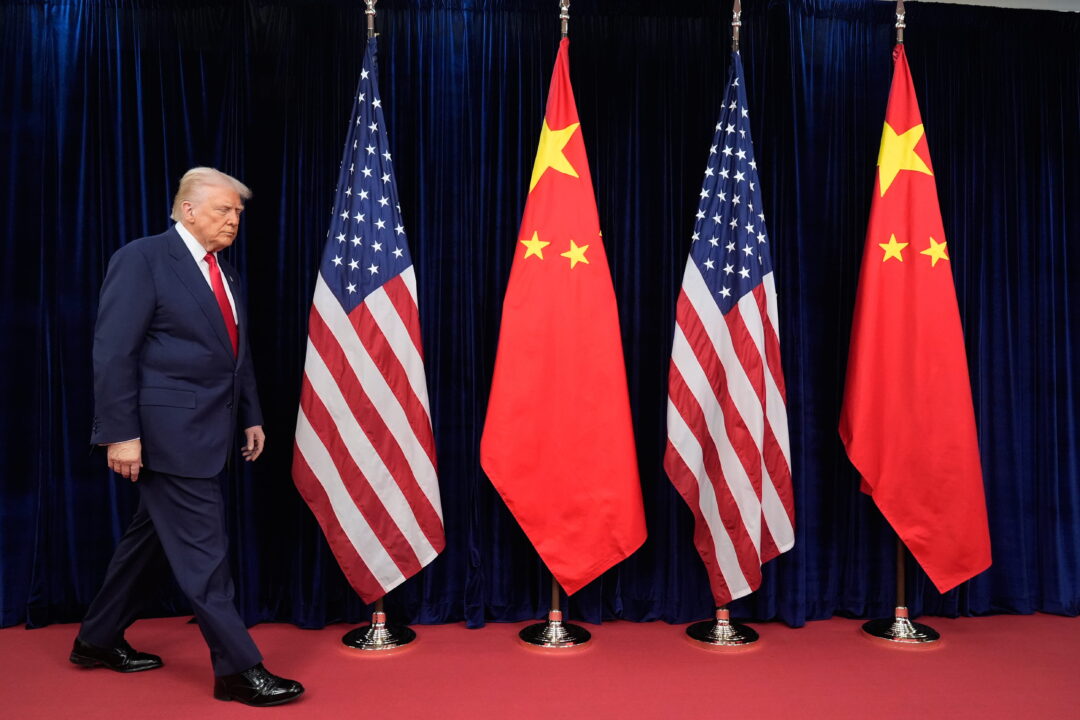
Mark Schiefelbein / AP / TT
Summary
- Unlike the first Trump administration, which largely worked against Beijing’s interests, the first year of its second term has clearly created more opportunities for China.
- Although some US policies impose costs and raise concerns for Beijing, a misguided trade war, diminished ideological pressure, weakened alliances, and a retreat from global order-building have tilted the balance in China’s favour.
- For the European Union, the situation presents difficult challenges. Transatlantic coordination on China policy has become more difficult. How Trump’s China policy will affect the EU remains uncertain, but it could embolden China’s efforts to undermine and weaken the Union.
The first administration of US President Donald J. Trump (2017–2021) marked a fundamental shift in US China policy. It altered the long-standing view – developed over successive administrations since the 1970s – that a stronger China is advantageous to the United States and that engagement with Beijing should therefore be the primary tool for managing relations. Trump argued instead that China’s rise had come at the expense of the United States. This shift ushered in a new paradigm of great power competition, characterized by intensified US efforts to counter China through ideological opposition, technological restrictions and challenges to trade relations.
One year into Trump’s second term, the US–China rivalry remains a defining feature of global politics. How has Trump II affected China– and, by extension, the broader great power competition? Below, this commentary assesses how the Trump administration’s policies have impacted the issues that matter most to the Chinese leadership and whether they have been positive or negative from the perspective of the Chinese Communist Party (CCP). The focus is on areas where Trump’s approach represents a change from the Biden administration. The analysis is grounded in prior research on Chinese interests and informed by media coverage and commentary on recent developments.
Chinese interest 1: Preserving Communist Party rule
The CCP’s overriding goal is to safeguard China’s one-party system. It remains concerned that foreign “hostile forces”, primarily the United States and its allies, are seeking to undermine its political rule. Thus far, Trump’s agenda has played to Beijing’s advantage.
Positive outcome: A directive issued by Secretary of State Marco Rubio has instructed US diplomats to downplay the promotion of democratic values in favour of emphasizing national sovereignty. Moreover, the recently published National Security Strategy states that the United States should refrain from “imposing on [other nations] democratic or other social change that differs widely from their traditions and histories”. This signals a shift away from the principle of holding autocratic leaders accountable for denying their citizens a voice in governance. To the CCP, this signals that the United States is unlikely to challenge the legitimacy of its political system on ideological grounds.
Positive outcome: The administration has implemented historic cuts to USAID and the US Agency for Global Media, reducing funding for civil society organizations documenting human rights abuses in China – as well as for Chinese-language media offering perspectives outside the Communist Party line. Unsurprisingly, the CCP’s media channels have lauded these decisions.
Chinese interest 2: Economic growth and technological leadership
Economic development underpins CCP legitimacy and China’s long-term goal of becoming a high-income country. In official strategy, this path runs through scientific and technological excellence. Against this backdrop, the Trump administration’s policies present a mixed picture for Beijing, although the overall tilt is clearly positive.
Negative outcome: The high US tariffs imposed on China and other countries clearly represent a downside for Beijing. They carry direct economic costs and contribute to uncertainty in the global economy – an unwelcome development for China as the world’s largest trading nation.
Positive outcome: Since the United States launched a renewed trade war against China in the spring of 2025, Beijing has broadened its use of export restrictions to include a wider range of strategic minerals. These measures have highlighted structural vulnerabilities in US supply chains and signalled China’s readiness to escalate economic coercion. The resulting pressure appears to have halted further aggressive trade actions on behalf of Washington and current US policy seems to prioritize efforts to stabilize bilateral ties. This successful use of economic deterrence is likely to influence future bilateral trade conflicts, given that China’s dominance in these value chains is expected to persist for years to come.
Positive outcome: In early December 2025, Trump approved the sale of Nvidia’s H200 chips to China. These chips are far more advanced than anything previously authorized by the United States. This decision marks a departure from previous policies aimed at curbing China’s progress on AI technology. US Critics argue that it could accelerate China’s efforts to close the gap with the United States in the development of AI.
Positive outcome: It is too early to assess how the inward-looking MAGA agenda will affect the ability of the United States to attract and retain top scientific talent. It is reasonable to assume however that it will have an impact – not least for scientists with Chinese backgrounds. Moreover, it is plausible that the sharp cuts in federal research funding will strengthen China’s position in scientific competition in fields with critical industrial and military applications.
Chinese interest 3: Reshaping the international order
China is seeking to advance its territorial claims in East Asia and reduce US influence while promoting a global order aligned with its interests. This includes efforts to prevent the formation of an anti-China coalition between the United States and its allies. Trump’s policies thus far have created greater opportunities than risks for Beijing.
Negative outcome: Early in 2025, Secretary of Defense Pete Hegseth signed Interim National Defense Strategic Guidance that officially designates Taiwan the “exclusive animating scenario” for US military planning. Deterring a Chinese invasion of Taiwan is now the top strategic priority, ahead of all other threats. Moreover, Prime Minister of Japan Takaichi Sanae clarified in December that Japan would be able to support the United States in a conflict over Taiwan – a stance that could reflect US pressure for greater clarity on the issue. The leaders of South Korea and Taiwan – both US military partners – have also set more ambitious defence budget targets, although how these plans will be implemented remains to be seen.
Positive outcome: The Trump administration has alienated key allies and partners, which makes it more difficult for Washington to build coalitions aimed at countering China’s growing influence. The aggressive US tariff policy towards Asian countries will make it more difficult to enlist them in policy initiatives targeting China. In Europe, the United States has incurred a major opportunity cost by failing to push the EU towards tougher China policies as part of a broader transatlantic deal. It has also made it a strategic objective to weaken the EU and pursue regime change among European allies – throwing transatlantic relations into crisis.
Positive outcome: The US reset with Moscow has eased Russia’s partial isolation and slowed the drift towards two Cold War-style blocs. This is welcomed by China since such a scenario could enable Washington to pressure allies into containing China. A stronger Russia, China’s most important partner, is to Beijing’s advantage.
Positive outcome: Even more than during Trump’s first term, the new US administration has displayed a disregard for international law, exemplified by actions such as its intervention in Venezuela, threats of military aggression against its ally, Denmark, and advocacy of what would amount to ethnic cleansing in Gaza. Such actions erode the political feasibility of rallying global support for a rules-based international order – let alone for promoting democratic and liberal values. In short, this has weakened the alternative to Beijing’s preferred vision for structuring international relations.
Implications for Europe
The trajectory outlined above has implications both for European–US coordination on China policy and for China’s approach to Europe.
US unilateralism, unpredictability and anti-EU sentiment have made coordinating China policy with Washington increasingly challenging for Europe. The same applies to the international environment in which China is rising: the United States is no longer a reliable partner in upholding a rules-based international order and shows little interest in defending universal values. This means that the EU must now craft its future China strategy without relying on US coordination or support.
Now that the United States has explicitly set out to weaken the EU, how will China respond? Will Beijing see this as an opportunity to align its efforts to undermine the EU with those of Washington and Moscow, given that all three support similar political forces within the Union? Or will it see a risk that a fragmented Europe could fall under US influence and therefore choose to strengthen EU institutions to preserve autonomy and prevent the Union from becoming a tool of US attempts to weaken China?
Thus far, there are few signs that Washington intends to pressure its preferred European partners, such as the Viktor Orbán government in Hungary, to choose between itself and China, which suggests that Beijing has more to gain from pursuing the first approach. Europeans should thus prepare for further overt – and covert – Chinese efforts to delegitimize European institutions and to cultivate anti-Brussels forces within the EU.