Andy Wong / AP / TT
Summary
- China approaches global governance through selective engagement and normative
contestation. It seeks not to dismantle the international order, but to reshape it to reflect
its own values – and ultimately to serve regime stability. - China is pursuing a two-pronged strategy of reforming existing institutions from within
while gradually launching and promoting its own alternatives. - This strategy seeks to capitalize on the long-term decline in western influence on global
politics, while also tapping into widespread resentment towards the West, liberalism and
democracy in many parts of the world. The Global South is its primary audience, and
China portrays itself as the leader of this imagined collective. - This is a long-term competition over the global governance structure, driven by powerful
trends that underpin China’s advancement. Success for democracies will require
engaging in normative competition, exploiting China’s systemic weaknesses, investing in
diplomatic capacity, building opportunistic coalitions and supporting institutional reforms
to reduce the appeal of Chinese alternatives.
Drivers of China’s approach: key interests and worldview
China’s approach to global governance is rooted in the Communist Party’s imperative to maintain regime stability and shaped by its interpretation of global trends. Such trends include the decline of western dominance, the rise of Asia and a shift to multipolarity and what China calls a “more democratic global order”.
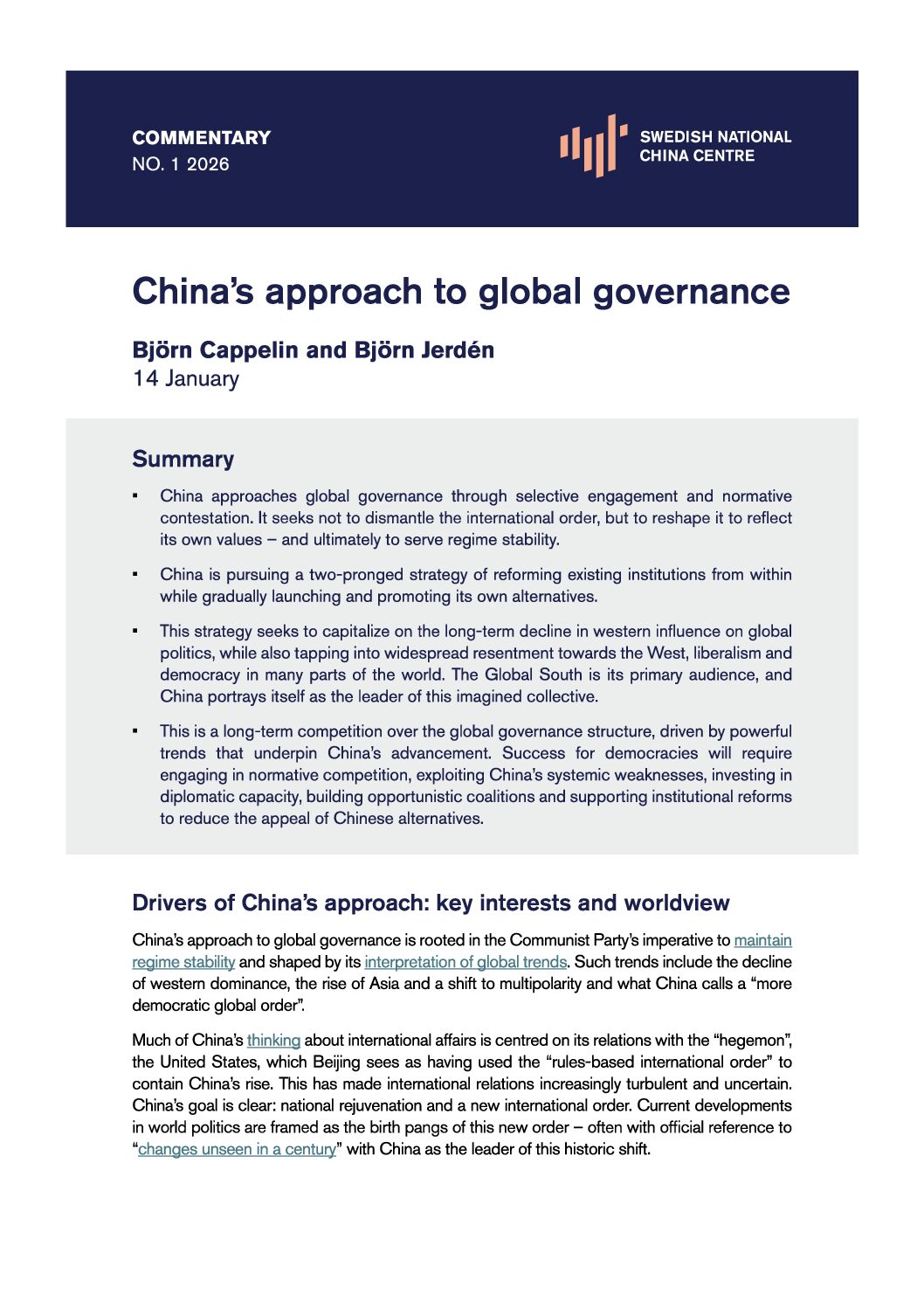
Much of China’s thinking about international affairs is centred on its relations with the “hegemon”, the United States, which Beijing sees as having used the “rules-based international order” to contain China’s rise. This has made international relations increasingly turbulent and uncertain. China’s goal is clear: national rejuvenation and a new international order. Current developments in world politics are framed as the birth pangs of this new order – often with official reference to “changes unseen in a century” with China as the leader of this historic shift.
China’s vision for the international order
China’s vision for the international order is centred on the United Nations (UN). State sovereignty and non-interference are presented as fundamental principles, although in practice China often pays only lip-service to them. China promotes contextualism, arguing that governance models should reflect national conditions. Its framing of human rights prioritizes practical problems over abstract principles, and thus challenges the liberal emphasis on individual freedoms. China hopes that this model will resonate in a world marked by cultural diversity and an overall decline of the liberal-democratic paradigm.
As an alternative, China promotes a collective, state-centric conception of rights and governance in which individual rights and civil society have no place in international affairs. China has also sought a diminished role for security alliances and, at least until recently, for unilateral sanctions, which it views as key instruments of US global influence.
China’s engagement in existing institutions
The current withdrawal of the United States from multilateral cooperation and the UN framework allows China to cast itself as the true champion of multilateralism and preservation of the international system. China has increased its financial contributions to UN agencies and peacekeeping operations, while also placing Chinese nationals in key leadership roles. This institutional presence allows China to influence normative and technical agendas, as well as norms on transparency and accountability.
In the economic domain, China has used its position in the IMF and the World Bank to promote alternative development models. These models often reject western conditionality and emphasize infrastructure and state-led growth, aligned with China’s domestic priorities.
In sum, China’s engagement with existing institutions is strategic, reformist and opportunistic. Despite signs of China increasing its contributions, this is mostly rhetorical posturing and it is unlikely that China has the means or the ambition to completely fill the gaps left by the US withdrawal from the international aid space.
China’s institutions and forums
China has built a parallel architecture of global governance through new institutions and forums. These tend to adopt values such as “win-win cooperation” and “development first” that reflect China’s governance philosophy.
The Belt and Road Initiative (BRI), launched in 2013, serves as a framework for projects across multiple sectors, primarily focused on infrastructure for transport, telecommunications and energy. Its core aim is to connect Eurasia through a network of land and maritime corridors, although other regions of the world have also been included.
The Asian Infrastructure Investment Bank (AIIB) and the New Development Bank (NDB) both serve to support China’s efforts to export its model of investment-led development.
China has launched several regionally focused cooperation forums, such as the Forum on China-Africa Cooperation, the China-Arab States Cooperation Forum and the Forum of China and the Community of Latin American and Caribbean States. The defunct 17+1 initiative, which sought to engage countries in Central and Eastern Europe, is another example. These forums operate under a “bi-multilateralism” model, where China engages bilaterally with participating states, allowing it to shape agendas while maintaining an appearance of inclusivity.
China is also a founding member of both the Shanghai Cooperation Organization (SCO), primarily focused on Eurasian security, and the BRICS which is seen as a challenge to western dominance in global economic policymaking. However, the divergent interests of their respective memberships constrain the efficiency of both organizations.
This establishment of parallel architectures increases China’s ability to set norms and influence development and security priorities, thereby reducing reliance on western-led institutions. It also serves to strengthen the perception of China as a leading actor in the Global South (see below).
China’s global initiatives
The Communist Party’s blueprint for a more China-friendly world order is encapsulated in its “global initiatives”. These should be understood as overarching ideas or diplomatic frameworks that lack concrete measures and tangible targets against which success can be measured, which makes them malleable and adaptable to changing circumstances. It appears that the purpose of the initiatives is chiefly to serve as rallying points for non-western countries and to cast China as a leader of those countries.
The first, the Global Development Initiative (GDI), was introduced in 2021. It seeks to position China as a leading actor in global development by promoting a vision that prioritizes economic growth over human rights. The Global Security Initiative (GSI), introduced in 2022, outlines a vision for international security based on the principle that no country’s security should come at the expense of another. It emphasizes non-interference and respect for state sovereignty, while rejecting so-called bloc politics and alliance-building. Its emphasis on “legitimate security concerns” can be interpreted as a legitimization of spheres of influence for major powers.
According to the Global Civilization Initiative (GCI), launched in 2023, the world comprises multiple civilizations, and no civilization – or definition of human rights – is superior to another. Humanity should thus strive for shared values such as peace, development, equality, justice and democracy. The initiative emphasizes the right of states to preserve their own history and culture, and to build social systems rooted in these traditions. This outlook is relativistic, effectively rejecting any fixed political concepts, but also portrays liberal democracy as a harmful, or even colonialist, western construct that is detrimental to the Global South.
The Global Governance Initiative (GGI), which advances global governance reform under Chinese leadership, was added in 2025. It stresses the underrepresentation of the Global South in global institutions, the lack of respect for the UN Charter and the need to address new global governance challenges linked to artificial intelligence, cyberspace and outer space. The GGI’s focus on consensus decision making illustrates China’s preference for multilateral solutions based on the lowest common denominator.
The central role of the Global South
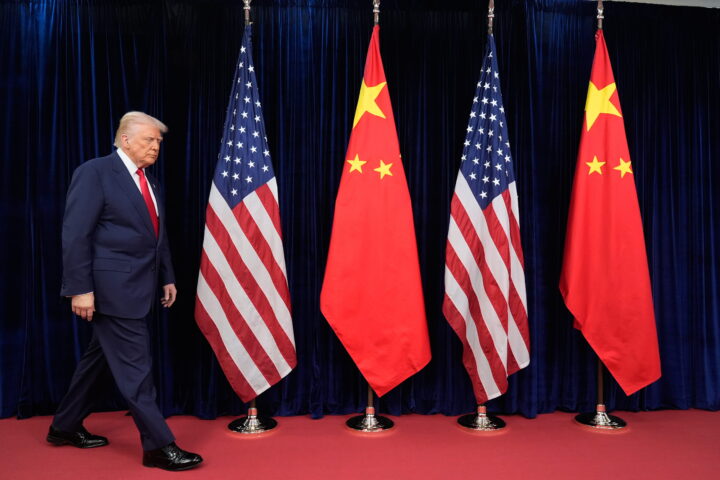
It is the Global South, not the West, that is China’s main audience. China’s message draws on a shared legacy of victimization under colonialism and imperialism and emphasizes solidarity. It promotes narratives of “win-win” partnerships, development without political conditions and “true multilateralism” that promises greater influence for Global South countries. Beyond economic incentives, China employs a systematic information strategy targeted at elites and the wider public in the Global South.
China claims that it will “always remain a developing country”. This is logically inconsistent, given that the core objective of Chinese policy – the “great rejuvenation” – is precisely to cease to be one. This claim reflects Beijing’s understanding of “developing country” as an identity marker, which allows it to position the United States and the West as actors on the opposing side of the developing world.
Gaining the support of the Global South is essential to China’s vision of global governance. Through the above frameworks and its extensive bilateral development cooperation, China is securing political support from its partners among developing and middle-income countries, including support at the UN for its priorities and initiatives, most notably recent support for national priorities and alternative interpretations in the field of human rights.
Policy recommendations for Europe
- Recognize the scope and long-term nature of the competition with China over global governance: This is fundamentally about shaping the future world order, not merely about bilateral relations with China. The Communist Party’s approach to global governance stems from its core beliefs and is unlikely to change without fundamental political transformation within China.
- Acknowledge how global, structural trends benefit China: The decline in western influence is real and has been unfolding for generations. This shift coincides with widespread resentment towards the West and a sense of vindication in many parts of the world. It will also likely be accompanied by greater normative diversity. China is not the driver of these trends and little can be done to reverse them.
- Engage in normative competition: Democratic states should actively compete to define norms, including in areas such as AI and digital governance, to defend liberal interpretations of human rights and democracy, and promote multistakeholder engagement, openness and accountability. China’s strategies to redefine key concepts in international law must be closely monitored and countered.
- Play to our strengths and China’s weaknesses: China bases many of its initiatives on the perceived success of its own development. While no one can deny China’s progress, the “China model” has significant flaws. China is still relatively underdeveloped and plagued by corruption and governance challenges. Its political system is inherently fragile and faces mounting pressures. China’s economic strategy is dependent on Global South countries continuing to tolerate lopsided trade flows. This presents opportunities for liberal democracies to strengthen ties with the Global South on a mutually beneficial trade agenda.
- Work with China where interests align: While China exhibits revisionist tendencies regarding global governance, it accepts many existing core institutions and practices. Collaboration should be pursued where it serves the interests of both sides.
- Invest in diplomatic capacity to counterbalance China’s lobbying efforts: Strengthen staffing and leadership in multilateral organizations and build coalitions with like-minded states such as Japan, South Korea, Canada.
- Support institutional reform: Support reforms that make existing global institutions more inclusive, thereby reducing the appeal of China’s alternative frameworks. This should include not only UN reform, but also efforts to make trade and development frameworks more broadly legitimate.