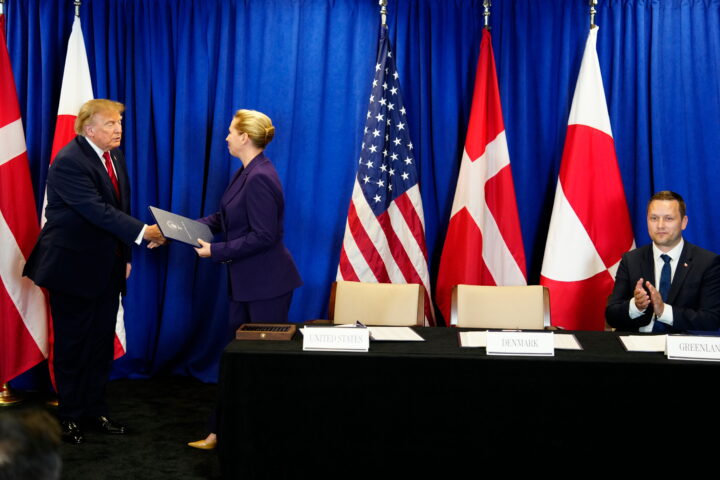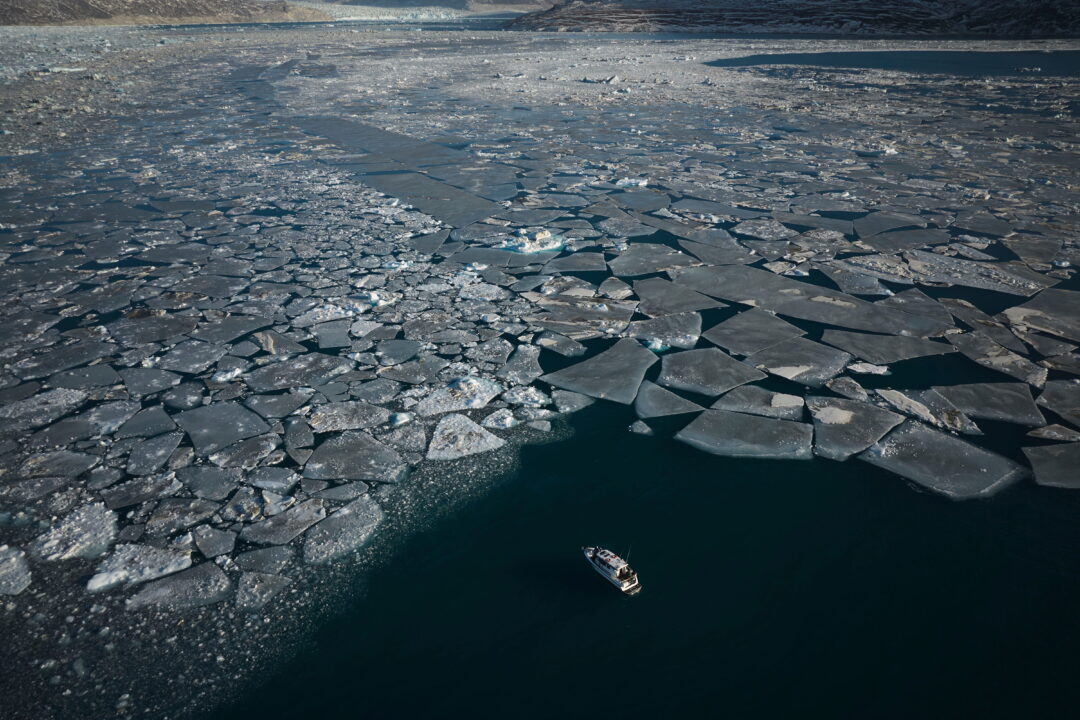
Emilio Morenatti / AP / TT
Summary
- This brief explores China’s preferences, constraints and likely responses in four scenarios related to Arctic geopolitics frequently discussed in policy analysis: polarised Arctic blocs, restored “Arctic exceptionalism”, US–Russia alignment and fragmented Arctic governance.
- All four scenarios involve both opportunities and risks for China. Scenarios involving increased securitisation in the Arctic are the least preferable to Beijing, given its lack of Arctic territory and resultant reliance on Arctic states for access to the region.
- As a non-Arctic state, China is constrained in its ability to shape wider Arctic developments. The Arctic is not a top Chinese priority, which limits the costs Beijing is prepared to bear in pursuit of its interests there.
- As a result, China is likely to remain a largely reactive Arctic actor for the foreseeable future, seeking to gradually expand its activities in selected sectors such as shipping and dual-use research while adapting to broader geopolitical conditions shaped primarily by the Arctic states.
- Nordic countries should continue to monitor Sino-Russian cooperation while preparing for the possibility of a more fragmented Arctic – not because it is the most likely outcome, but due to the instability and unpredictability such a scenario might bring.
The Arctic has re-emerged as a hotspot for geopolitical competition, if not yet outright confrontation. While Russia’s 2022 invasion of Ukraine has accelerated this development, climate change has been the primary long-term driver, along with technological advances and the spillover from global US–China rivalry. At the same time, Arctic governance has grown more complex. While the eight “Arctic states” remain the primary actors, it now involves a broader range of stakeholders to varying degrees, such as indigenous organisations, commercial actors, numerous international institutions and frameworks, and a growing number of non-Arctic states – most notably China.
China’s emergence as a major Arctic actor in areas such as shipping, resource projects and strategic science represents a significant development of the past two decades. China has a long-term Arctic strategy, but its implementation can at times be shaped by actors in specific sectors advancing their own interests or aligning their activities with broader policy initiatives such as the Polar Silk Road. In terms of priorities, the Arctic is not a “core” Chinese interest; those lie much closer to home. Nonetheless, Beijing views the Arctic as an increasingly important part of its maritime strategy and as a “strategic new frontier”, where great powers compete for resources, influence and leadership on future governance and technological standards. Importantly, the Arctic is not a homogeneous region but several subregions, each with unique political and security dynamics that shape where and how external actors like China can engage.
Against this backdrop, different scenarios can be envisaged for the future of the Arctic and China’s role. This brief explores China’s preferences in and possible responses to four main scenarios frequently discussed in the policy literature: polarised Arctic blocs, restored “Arctic exceptionalism”, US–Russia alignment and fragmented Arctic governance. For the Nordic countries, whose Arctic territories have effectively become part of NATO’s northern flank, it will be crucial to prepare for each scenario.
Arctic governance
The Arctic governance framework comprises a patchwork of international institutions, multilateral forums and legal regimes, with agreements covering areas such as maritime boundaries and continental shelf claims (United Nations Convention on the Law of the Sea, UNCLOS), fishing (the Central Arctic Ocean Fisheries Agreement) and shipping (the IMO Polar Code).
Established in 1996 by the eight circumpolar states – Canada, Denmark, Finland, Iceland, Norway, Russia, Sweden and the United States – the Arctic Council is the leading intergovernmental forum for dealing with Arctic issues. It focuses on sustainable development and environmental governance, while security and defence issues are explicitly excluded.
The Council operates on a consensus basis among the eight member states. The admission of 13 observer states, including China, has given non-Arctic countries an opportunity to participate in its work, albeit without voting rights.
Since Russia’s 2022 invasion of Ukraine, the forum has operated at limited capacity. The working groups partially resumed their activities in virtual format in 2024 but high-level meetings remain suspended.
Sweden, which unveiled its new Arctic strategy in June 2026, will assume the two-year rotating chair in May 2027.
Analyses of Arctic geopolitics have identified factors such as geopolitical tensions and institutional dynamics in shaping outcomes, but vary in terms of the specific variables selected and how these are combined in scenario models.
While acknowledging the uncertainty of geopolitical developments, this brief frames the four scenarios as shaped by two variables: the degree of great power confrontation or accommodation and the resilience of Arctic governance institutions and regulatory frameworks (see Figure 1). Smaller Arctic states also shape local developments, not least in their role as effective gatekeepers to external actors, but major powers tend to have more influence on the broader geopolitical conditions, especially in times of heightened tension and securitisation.
Although the two variables influence each other, they also operate with a degree of independence. Arctic institutions have proved relatively resilient even during periods of high geopolitical friction, which suggests that they can be at least partially buffered from global conflicts.
Figure 1. Scenarios for Arctic geopolitics
Note: The figure presents four scenarios based on variations in two variables: the resilience of Arctic governance institutions and regulatory frameworks, and the level of great power confrontation or accommodation. The position of each ellipse within a quadrant indicates relative variations in the intensity of the two variables.
Scenario 1: Polarised Arctic blocs
This scenario resembles a continuation of the status quo. Despite US President Donald J. Trump’s disregard for and threats to US allies, Arctic geopolitics remains largely structured along two partially polarised blocs: the seven Arctic NATO states (the “A7”) on the one hand, and Russia and the non-Arctic state, China, on the other.
Arctic governance mechanisms survived the shock of Russia’s full-scale invasion of Ukraine and have shown relatively high but uneven levels of resilience. At the forum level, although the Arctic Council has not collapsed, ministerial meetings have been suspended and working group activities are limited to virtual formats. Moreover, Russia has withdrawn from several regional forums. While the institutional architecture is mostly intact, practical cooperation has been severely affected.
By contrast, Arctic legal regimes have shown greater resilience, as states continue to rely on the UN Convention on the Law of the Sea (UNCLOS) and other international agreements to manage disputes and regulate the use of Arctic resources and activities.
There is no lack of tension within the two blocs: relations between the United States and the other Arctic NATO members have been severely strained, especially by Trump’s threats to seize Greenland, while Russia and China are partners of necessity rather than choice, and neither is willing to go “all in” on the partnership.
Polarisation in two blocs was already taking shape before Russia’s invasion of Ukraine, but has since solidified due to the subsequent isolation of Moscow and resentment in the Nordic states over China’s economic and diplomatic support for Russia.
This scenario entails a securitisation of the Arctic that is not aligned with China’s interests. While Beijing may be able to leverage its growing influence over Moscow to expand access to the Russian Arctic, its broader ambitions are constrained by unity among the Arctic NATO members. China continues to rely on and prioritise Arctic cooperation with Russia.
Scenario 2: Restored Arctic exceptionalism
The second scenario sees a return to the status quo ante, often described as Arctic exceptionalism – the idea that Arctic cooperation can be largely insulated from broader geopolitical conflicts, although this notion is contested.
Under this scenario, following a Ukraine peace agreement, sanctions on Russia are gradually lifted, the working groups resume physical meetings and the Arctic Council resumes high-level meetings shortly after.
This scenario entails NATO and Russia restoring cooperation but not a complete rapprochement or the formation of a US–Russia bloc (as in Scenario 3). Ultimately, the United States and Russia decide to reinforce the existing governance framework because it serves their interests by improving predictability and helping to constrain the role of non-Arctic states such as China.
For China, despite these constraints, this scenario is preferred to the current pattern of polarisation in two blocs, as Arctic cooperation is partially de-securitised. A complete return to the pre-2014 – or even 2022 – situation is unlikely, given structural changes such as Finland and Sweden’s accession to NATO, as well as the continued use of investment screening and “de-risking” policies. Even so, Chinese activities face less scrutiny than today.
China loses some leverage over Russia as Moscow gains more options. Furthermore, this scenario results in the reinforcement of a governance system that China regards as unfair and exclusionary to non-Arctic states. China would be expected to respect the existing governance framework while seeking to incrementally reshape it, rather than challenge it directly.
Scenario 3: US–Russia alignment
This scenario assumes a US–Russia rapprochement. The Trump administration’s efforts to reset relations with Russia – including its effective abandonment of support for Ukraine, and pursuit of high-level engagement and joint Arctic energy and mining projects – continue and intensify.
Arctic governance structures remain mostly intact but lose relevance as Russia and the United States decide on Arctic issues bilaterally rather than through multilateral institutions. Such deals sideline European interests and push the Nordic states and Canada closer in the Arctic. This, in turn, results in the formation of two blocs: a great power bloc of the United States and Russia, and a bloc of small and middle Arctic powers. Irreconcilable political differences push NATO to the brink of collapse. The A7 becomes less cohesive and less relevant as a bloc.
While the Sino-Russian Arctic partnership remains robust, Russia’s dependence on China is reduced somewhat, and so too is Beijing’s leverage over Moscow. China positions itself as a viable alternative partner for Nordic countries by advocating Arctic multilateralism, sustainable development and respect for indigenous peoples’ rights, areas which are unlikely to be prioritised by a US–Russia bloc.
Scenario 4: Fragmented Arctic governance
The fourth scenario envisages the partial collapse of the Arctic governance system, which could unfold in two ways. In one version, fragmentation occurs both between the A7 and Russia and within the A7 itself. In a softer variant, the Arctic Council is abolished and replaced by alternative forums but the A7 bloc remains politically united.
In the former, geopolitical frictions escalate to the point where neither multilateralism nor great power accommodation are viable. US–Russia relations deteriorate, the A7 bloc crumbles, NATO loses its unity and relevance in the Arctic, and efforts to pursue Arctic diplomacy through cooperative frameworks and stakeholder engagement are unsuccessful.
Russia, which has in recent years explicitly conditioned its commitment to the Arctic Council on it remaining “constructive”, finally withdraws, triggering its collapse. Several competing forums emerge – one led by the United States, one led by Russia and one led by the Nordic countries, the EU and Canada, resulting in fragmented Arctic governance. The alternative platform established by Russia invites the BRICS+ countries and other targeted partners to participate.
In the softer, more likely variant, the Arctic Council collapses and is replaced by competing forums led by the A7 and Russia. Despite frictions over Greenland and other issues, NATO survives and the A7 remains largely united. Fragmentation is less severe in this version, albeit significantly deeper than in the other scenarios.
Even in this scenario of increased friction and fragmentation, Arctic legal regimes are likely to prove more durable, although they too may come under greater strain.
In both versions, China gains new opportunities to shape governance norms. At the same time, Moscow’s welcoming of the BRICS+ countries into Arctic governance risks weakening Beijing’s position as Russia’s primary strategic partner to some degree.
In a highly securitised Arctic, China, while continuing to rely on Russia, hedges between the competing blocs, maintaining some balance between Europe and Russia to avoid heightened European de-risking measures.
Table 1. Four scenarios of Arctic geopolitics: China’s opportunities, risks and possible responses.
Concluding thoughts
For China, all four scenarios present both opportunities and risks, but they are not equally preferable (see Table 1). Given China’s lack of Arctic territory, a further securitisation of the region would be contrary to its interests as it increases barriers to access and engagement in Arctic projects.
At the same time, China’s ability to shape wider Arctic developments is limited and mostly indirect. While China has growing leverage over Russia, it is unlikely to demand major concessions in the Arctic, given its dependence on Russia for access to the region and the importance of the broader Sino-Russian partnership. Moreover, although China views the Arctic as increasingly strategic, it does not constitute a top Chinese priority, which limits the costs Beijing is prepared to incur in pursuit of its interests there.
China can be expected to remain a mostly reactive and adaptive Arctic actor for the foreseeable future, seeking to expand its activities in sectors such as shipping and research – some with dual-use potential – while operating within the broader conditions shaped by the Arctic states. China may seek to reshape Arctic governance over the longer term, but is unlikely to challenge Arctic legal regimes directly, instead continuing to rely on them to legitimise its presence and role as an “Arctic stakeholder”.
While continuing to monitor Sino-Russian cooperation, Nordic countries should prepare for the possibility of a more fragmented Arctic – not because it is the most likely outcome, but due to the potential instability and unpredictability of such a scenario.
关于作者