Mads Claus Rasmussen / Scanpix / TT
Summary
- The updated defense agreement between the United States, Greenland and Denmark restricts countries deemed hostile to the United States from establishing a military presence in Greenland or gaining significant influence in strategic sectors such as critical infrastructure and mining projects.
- In practice, however, China had already been effectively excluded from major new strategic investments in Greenland by means of informal coordination, political pressure, and broader Western de-risking efforts.
- The agreement does not so much transform the status quo as formalize existing trends, but at the cost of significant damage to US relations with Denmark and Greenland and to the broader transatlantic relationship.
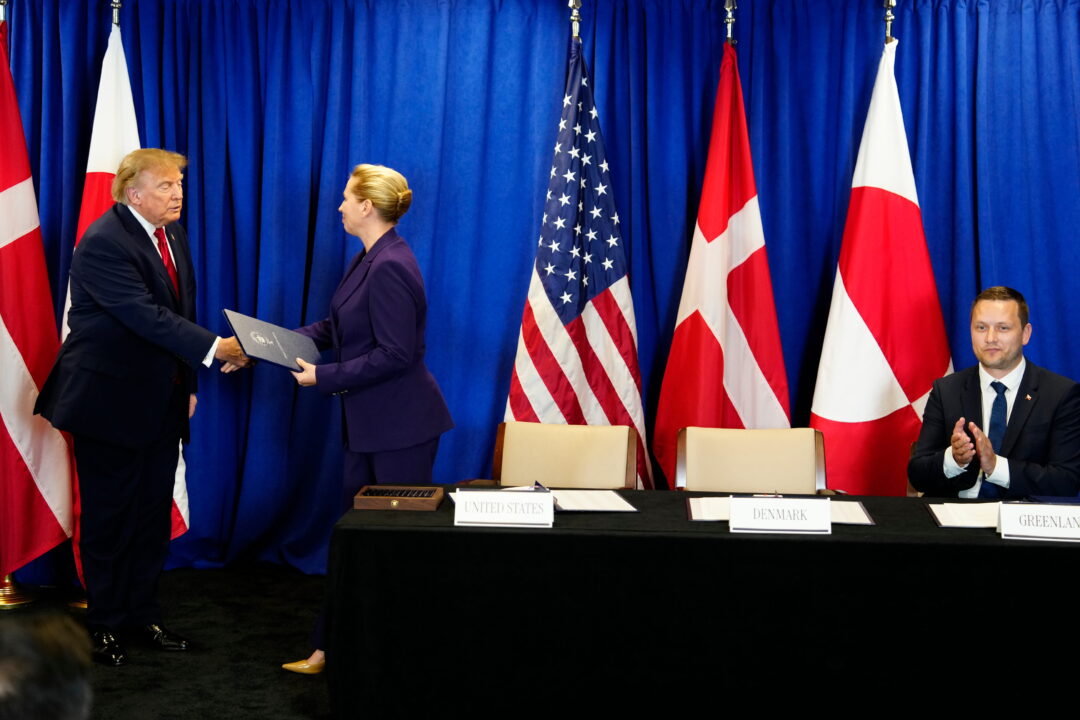
On 22 September 2026, US President Donald J. Trump, Danish Prime Minister Mette Frederiksen and Greenlandic Prime Minister Jens-Frederik Nielsen jointly signed an agreement that updates the Greenland security framework established by the 1951 Defence Agreement and last revised through the 2004 Igaliku Agreement. Entry into force requires the completion of parliamentary procedures in Denmark and Greenland, followed by diplomatic notification to the United States.
The agreement follows months of pressure from the White House, including repeated threats to annex Greenland to protect it against Chinese influence and other alleged security threats. The United States highlights that the new agreement prohibits adversaries from establishing military bases in Greenland and restricts their investments in strategic sectors, including critical infrastructure and mining projects.
But, as I have argued elsewhere, China had already been effectively shut out of major new strategic investments in Greenland. Even under the previous security arrangement between the United States, Denmark and Greenland, substantial Chinese investment was highly unlikely, and a Chinese military base in Greenland was not a realistic prospect.
Rather than a fundamental shift, the new agreement should be seen as the institutionalization of an informal system that already allowed Denmark, often in close coordination with the United States, to effectively block sensitive Chinese investment or activities in Greenland.
How is the agreement viewed in China?
While the Greenland agreement has been all over Western media, it has received less attention in China and, as of 24 September, the Chinese government has not commented on it officially. Official media coverage has been limited and cautious, often referring to Western media commentary while avoiding direct discussion of what the agreement may mean for China.
For example, Xinhua News Agency pointed to concerns in Denmark that Trump may not fully respect the agreement or could try changing it. CCTV, China’s national television broadcaster, highlighted the absence of an expiration date in the agreement. The report also focused on restrictions on non-NATO members, or countries regarded as hostile to the United States, from establishing military installations or making sensitive investments. However, it did not discuss the implications for China directly.
Global Times, a Chinese tabloid closely linked to the Communist Party, quotes a Shanghai-based researcher as arguing that the agreement shows Washington’s ambition to “monopolize” Greenland and transform it into a military outpost. The researcher highlights Greenland’s role in the proposed “Golden Dome” missile defense system and suggests that the island could eventually host missile deployments. He also portrays the agreement as part of a broader US effort to control the region’s rare earths and other strategic resources.
What actually changes for China?
Article 9 of the agreement states that “No state that is not a member of NATO shall be allowed to establish its own manned or unmanned military installations in Greenland nor shall they be allowed a persistent presence of military forces in Greenland, unless otherwise agreed by the Parties”.
Furthermore, Article 10 effectively prohibits states, and investors from states, that are not NATO members, NATO partners or EU member states from obtaining control or significant influence in “particularly sensitive sectors”, including critical infrastructure and resource extraction, unless the parties agree otherwise.
The 2004 Igaliku Agreement contained no such provisions. On paper, therefore, the 2026 agreement appears to break new ground by giving the United States a de facto veto over Chinese investment in sensitive sectors in Greenland.
In practice, however, this outcome had already been achieved in all but a formal sense. Since the first Trump administration (2017-2021), the United States and Denmark have relied on informal mechanisms and political pressure to effectively block or prevent sensitive Chinese investment in infrastructure or critical minerals in Greenland.
In the past several years, Chinese mining companies, many of which already appeared to be losing interest in Greenland because of economic and logistical challenges, have faced increasing political scrutiny. Furthermore, as Western countries intensified efforts to “de-risk” supply chains from China, Western firms have grown increasingly wary of Chinese partners – particularly in geopolitically sensitive locations like Greenland – and faced strong incentives to reduce, downplay, or avoid Chinese participation in critical mineral projects.
Taken together, these factors made substantial Chinese investment in Greenland highly unlikely, even without this new agreement. Rather than shutting China out of Greenland, the agreement codifies an exclusion that had already been realized in practice.
Was the price worth paying for the United States?
The agreement is significant in that it formalizes the exclusion of China from strategic sectors in Greenland. It also appears to make it difficult for a potentially independent Greenland to reverse course in the future, even if a Greenlandic state would almost certainly have been drawn more closely into the US orbit regardless. Much of what the agreement contains could probably have been accomplished through friendly negotiations with Denmark and Greenland, without the need for threats and other forms of pressure.
While Trump has shown a tendency to revisit deals he no longer finds satisfactory, the agreement appears, at least temporarily, to have brought a moment of relief for Denmark, Greenland, and Europe. An agreement has been signed, and the United States did not acquire sovereignty over Greenland. It has, however, come at the cost of considerable damage to US relations with Denmark and Greenland, as well as to the broader transatlantic relationship.



China already left – so what is Trump’s Greenland gambit about?